For Therapists & Clinicians
The Splayometer fills a long-standing measurement gap in hand rehabilitation, providing quantitative data for extension and abduction force that has never before been available from a commercial instrument.
Why Objective Measurement Matters
Quantitative strength data is foundational to evidence-based practice in hand therapy. The absence of an instrument for extension and abduction force has been a persistent gap.
Current Limitations
Manual muscle testing — the current standard for extension and abduction assessment — requires the examiner to resist the patient's motion with their own hands. The result is an ordinal grade (0–5) that is inherently subjective and examiner-dependent.
This introduces inter-rater variability that limits the reliability of serial measurements, complicates progress tracking, and weakens the defensibility of clinical documentation for medico-legal or insurance purposes.
Grip dynamometers and pinch gauges have long provided reliable quantitative data for adductive and compressive force. Extension and abduction have had no equivalent — until now.
Establish Initial Function
Quantify extension and abduction force at the outset of a course of care to establish a reliable numeric baseline for each digit and the whole hand.
Track Change Over Time
Serial measurements with a consistent instrument allow meaningful comparison across sessions — removing examiner variability from the equation.
Defensible Clinical Records
Numerical force data strengthens documentation for clinical, insurance, and medico-legal purposes in ways that ordinal grades cannot.
Standard Protocol
The Splayometer integrates into existing hand assessment workflows with a consistent, three-trial measurement protocol.
Select the Digit Pair
Identify the target digit(s). Choose appropriately sized finger rings for the digit and thumb being tested, or attach the hand loop for whole-hand assessment.
Instruct the Patient
Demonstrate the desired motion — extension, abduction, or whole-hand opening — and ensure the patient understands the direction of force to apply.
Perform Three Trials
The patient performs the movement three times at maximum voluntary effort. Record the peak force achieved in each trial as displayed on the device.
Calculate & Document
Compute the average or maximum value across trials. Document the result as a quantitative force value alongside any other hand assessment data.
Individual Digits and the Whole Hand
The Splayometer's interchangeable attachment system allows targeted assessment of any finger-thumb pair in isolation, as well as interosseus whole-hand strength.
Thumb-Finger Extension
One finger ring on the target digit, one on the thumb. The patient extends the finger away from the thumb. Any of the five digits can be tested individually using size-appropriate rings.
Inter-Finger Spreading
Finger rings on two adjacent fingers. The patient spreads the fingers apart. Useful for assessing intrinsic hand muscle function and dorsal interosseous strength.
Hand Extension & Abduction
The hand loop encircles all four fingers and optionally the thumb. The patient opens the hand against resistance. Provides a composite measure of total hand extension force.
Precision and Flexibility
The Splayometer delivers the features clinicians need for consistent, accurate measurement.
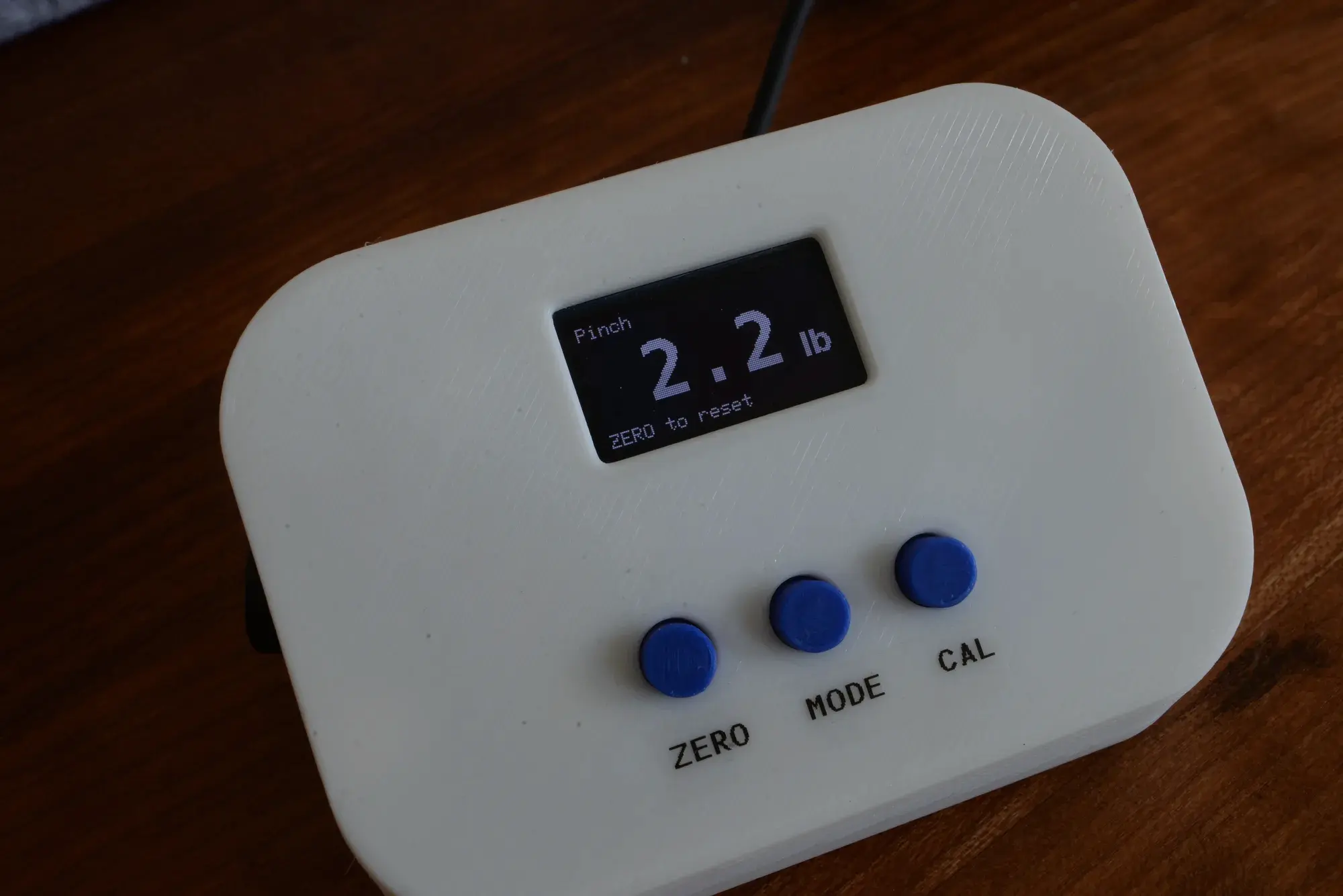
- Numerical Display — precise force readings shown on a digital readout module
- Calibration & Tare Functions — maintain accuracy and adjust for individual workflows
- Flexible Positioning — separate display and load cell allow optimal placement during measurement
- Accepts interchangeable finger ring and hand loop attachments via the twist-lock interface
Standard Use Procedures
Detailed measurement protocols are available now in the Standard Use Procedures guide.
Reference Norms
Published normative values for finger extension and abduction force to compare against measured results.
Questions or Clinical Inquiries?
We welcome inquiries from clinicians, researchers, educators, and healthcare institutions interested in the Splayometer.