Standard Use Procedures
Attachment locations, structures tested, and functional tasks for each Splayometer measurement.
How to use these procedures
Following the same protocol each time makes measurements comparable across sessions and examiners.
Intended Use
Clinical measurement of finger and hand extension and abduction strength, for use by occupational and physical therapists and other healthcare professionals. Typical uses include:
- Baseline measurement at the start of a course of care
- Serial measurement to track progress over time
- Comparison of the affected and unaffected hand
- Outcome documentation for clinical, insurance, or medico-legal purposes
Guiding Clinical Framework
In the Occupational Therapy Practice Framework (4th ed.; AOTA, 2020), strength is a client factor: muscle power, under neuromusculoskeletal and movement-related body functions. The Splayometer measures this client factor for finger and hand extension and abduction.
Standard Positioning Guidance
Seat the patient with the shoulder adducted and neutrally rotated, elbow flexed at 90°, forearm in neutral, and wrist between 0° and 30° extension, the position used for the Mathiowetz et al. (1985) grip and pinch norms. Use the same position in every session.
Finger-to-Thumb Extension
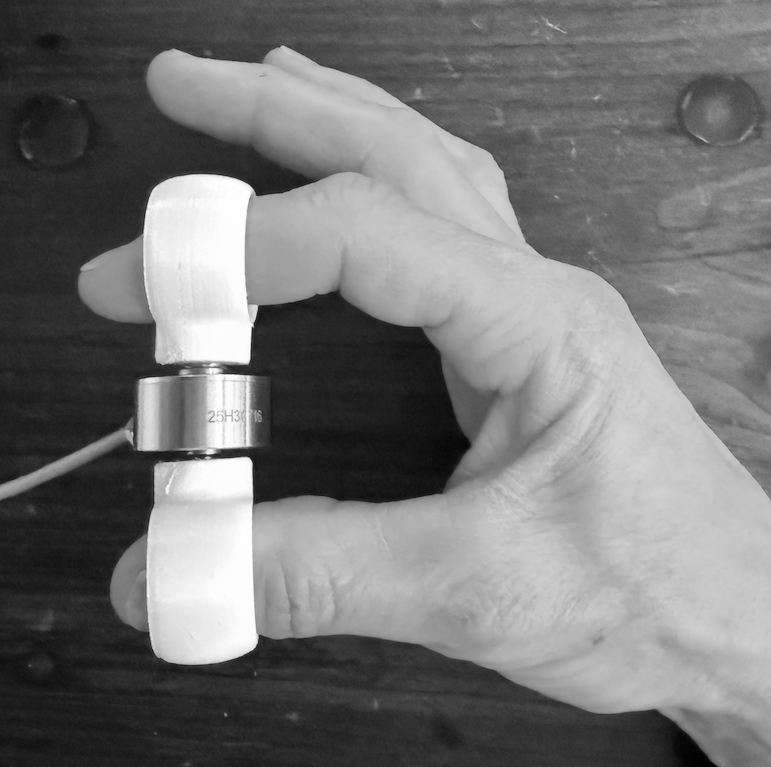
Attachment location
One ring on the middle phalanx of the target finger, between the proximal and distal interphalangeal (PIP and DIP) joints. One ring on the proximal phalanx of the thumb, between the metacarpophalangeal (MCP) and interphalangeal (IP) joints; exact placement is at the clinician’s discretion.
Structures tested
- Finger extension at the MCP joint: extensor digitorum communis, plus extensor indicis proprius (index finger) and extensor digiti minimi (little finger). Innervation: posterior interosseous nerve, from the radial nerve (Doyle & Botte, 2003).
- Extension of the PIP and DIP joints through the extensor hood: interossei and lumbricals. Innervation: interossei by the deep branch of the ulnar nerve; lumbricals 1–2 by the median nerve, 3–4 by the ulnar nerve (Launico & Varacallo, 2025).
Functional tasks that use this motion
- Releasing a pinched object, such as a coin, bead, or button
- Opening the jaws of scissors or similar tools
- Opening a zip-top bag or resealable pouch
- Separating sheets of paper from a stack
- Releasing a pencil or similar tool
- Adjusting a small object held between thumb and finger
Single Finger Extension
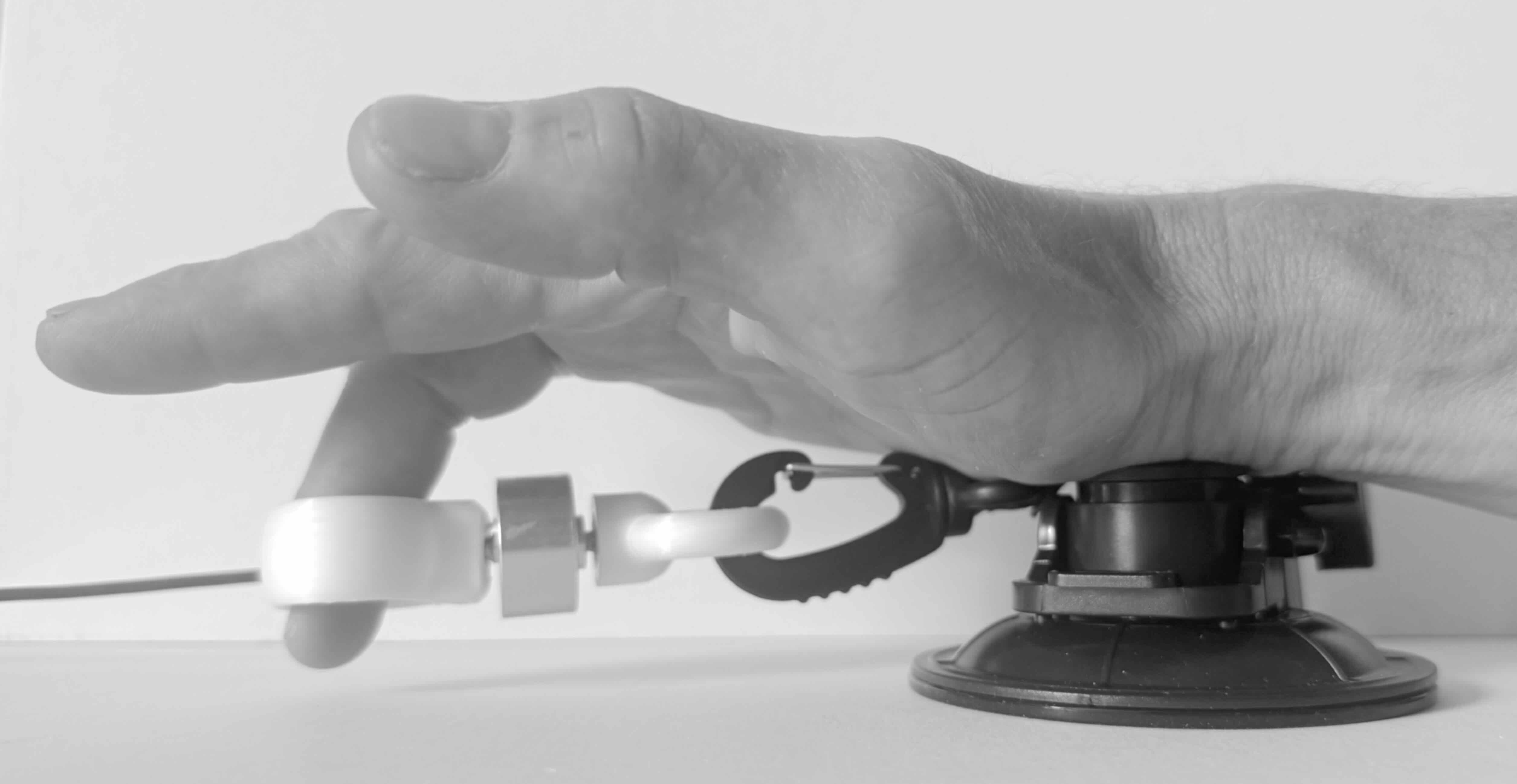
Attachment location
One ring on the middle phalanx of the target finger (index, middle, ring, or little). A suction cup anchor, sold separately, connects to the load cell to allow isolation of a single finger.
Structures tested
- Finger extension at the MCP joint: extensor digitorum communis, plus extensor indicis proprius (index finger) and extensor digiti minimi (little finger). Innervation: posterior interosseous nerve, from the radial nerve (Doyle & Botte, 2003).
- Extension of the PIP and DIP joints through the extensor hood: interossei and lumbricals. Innervation: interossei by the deep branch of the ulnar nerve; lumbricals 1–2 by the median nerve, 3–4 by the ulnar nerve (Launico & Varacallo, 2025).
Functional tasks that use this motion
- Pointing at an object, icon, or location
- Turning a page with one finger
- Lifting a finger off a key, button, or touchscreen
Hand Extension & Abduction
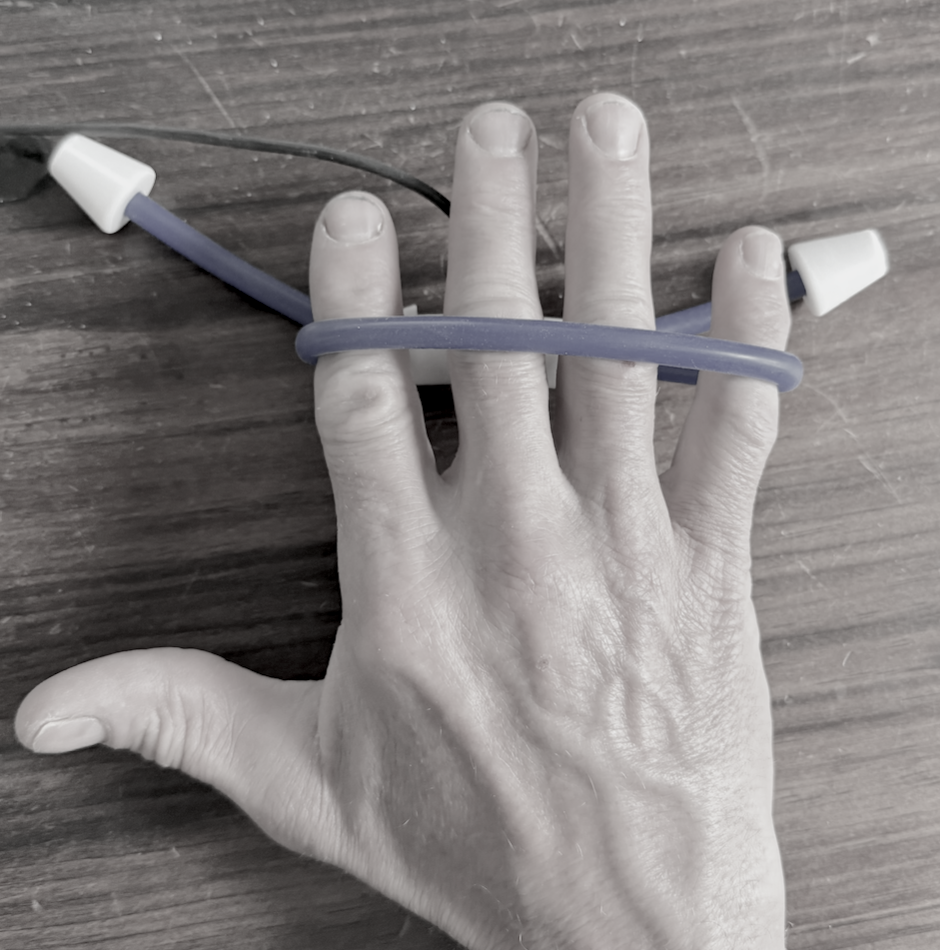
Attachment location
The hand loop encircles the four fingers (index through little) at about the middle phalanges, or elsewhere at the clinician’s discretion. The thumb may be included or excluded.
Structures tested
- Finger abduction: dorsal interossei (index, middle, and ring fingers) and abductor digiti minimi (little finger). Innervation: deep branch of the ulnar nerve (Launico & Varacallo, 2025).
Functional tasks that use this motion
- Spreading the hand to grasp a large object, such as a ball, jar, or door handle
- Placing the hand into a glove
- Spanning an octave on a piano or fretting a guitar chord
- Releasing an object by opening and spreading the fingers
- Washing or drying between the fingers
The Three-Trial Standard
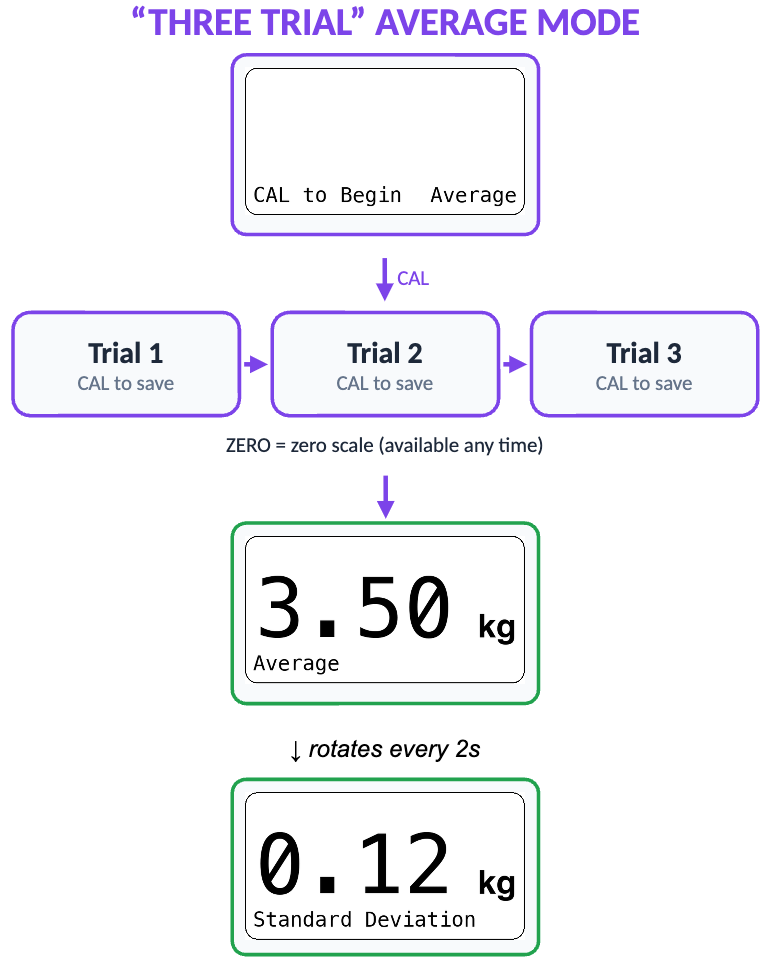
Mathiowetz et al. (1984) found that test–retest reliability of grip and pinch strength was highest when the mean of three trials was used, and reported the American Society of Hand Therapists' recommendation that “the mean of three successive trials be used as the measure of grip strength.” The Splayometer’s Average mode records three trials.
Scoring
In Average mode, the Splayometer records the peak of each trial and displays the mean and standard deviation of the three trials.
Bibliography
Sources cited on this page.
- American Occupational Therapy Association. (2020). Occupational therapy practice framework: Domain and process (4th ed.). American Journal of Occupational Therapy, 74(Suppl. 2), 7412410010. https://doi.org/10.5014/ajot.2020.74S2001
- Doyle, J. R., & Botte, M. J. (2003). Surgical anatomy of the hand and upper extremity. Lippincott Williams & Wilkins. (pp. 134–135, 141–142)
- Launico, M. V., & Varacallo, M. A. (2025). Anatomy, shoulder and upper limb, hand intrinsic muscles. In StatPearls. StatPearls Publishing. https://www.ncbi.nlm.nih.gov/books/NBK539810/
- Mathiowetz, V., Kashman, N., Volland, G., Weber, K., Dowe, M., & Rogers, S. (1985). Grip and pinch strength: Normative data for adults. Archives of Physical Medicine and Rehabilitation, 66(2), 69–74.
- Mathiowetz, V., Weber, K., Volland, G., & Kashman, N. (1984). Reliability and validity of grip and pinch strength evaluations. Journal of Hand Surgery, 9(2), 222–226. https://doi.org/10.1016/S0363-5023(84)80146-X
Explore Reference Values
Published references for comparison with Splayometer measurements.