Conditions Involving Extension and Abduction
A clinical reference to the diagnoses, injuries, and rehabilitation contexts that involve finger and hand extension and abduction.
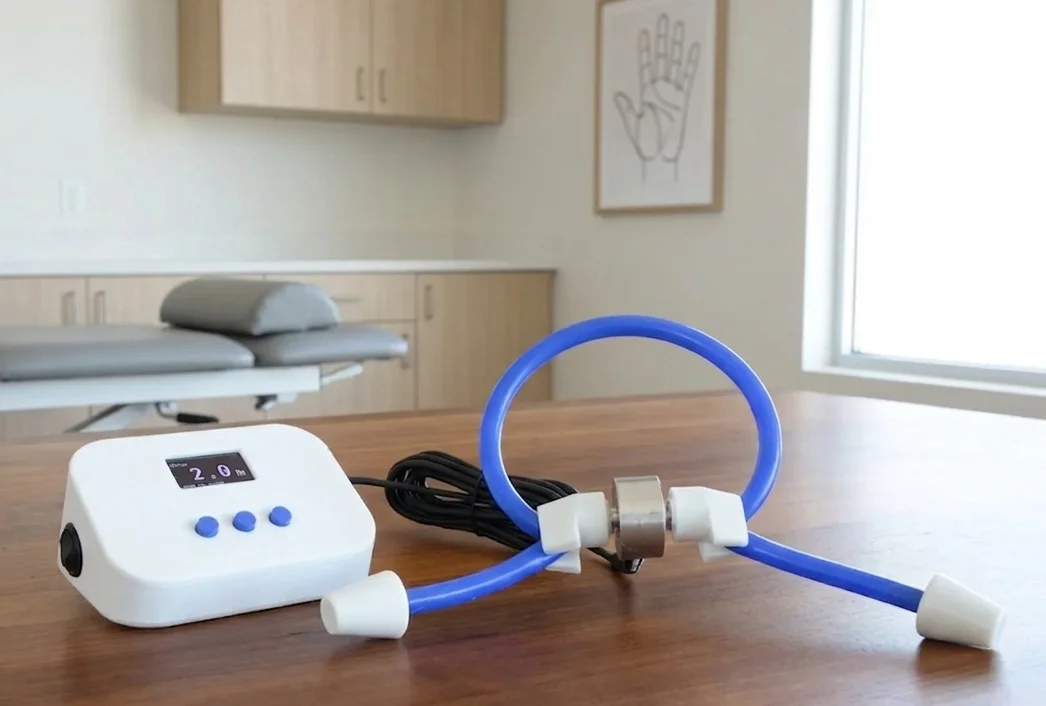
The Splayometer is a measurement device. It measures finger and hand extension and abduction force. The conditions on this page are described for clinical and educational context.
Grip Can Be Preserved While Extension Is Severely Impaired
Extension and abduction are structurally independent from flexion and compression, with different muscles, nerves, and tendons.
In hand surgery and rehabilitation, the "grip-preserved" pattern is common. Radial nerve palsy leaves all flexors untouched; a patient can grip a dynamometer while being unable to open the hand.89 Ulnar nerve injury spares median-innervated flexor digitorum profundus to digits 2–3 and all flexor digitorum superficialis, so substantial grip force remains while interossei and lumbricals are weak or paralyzed.82
Manual muscle testing, the current standard for assessing extension, produces an ordinal 0–5 grade that is inherently examiner-dependent. Its reliability is well-characterized and limited, particularly at the low end of the scale where early motor recovery appears.13
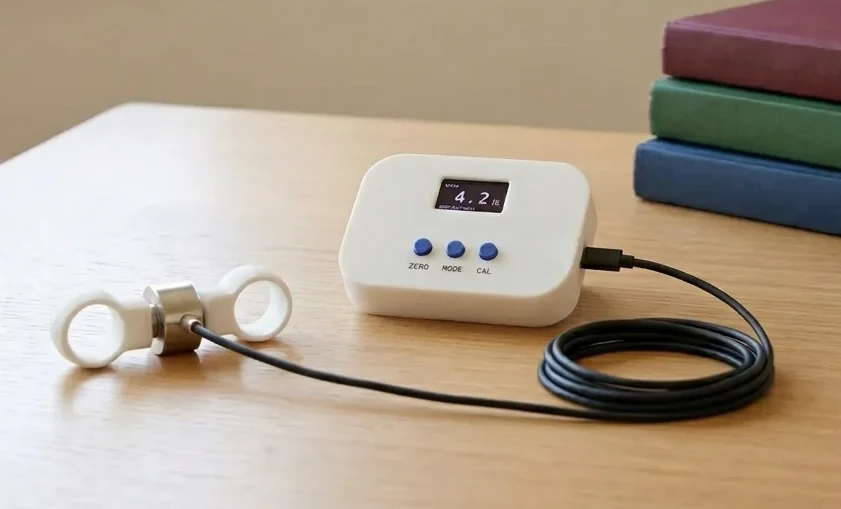
Grip dynamometers and pinch gauges have long provided reliable quantitative data for compressive and adductive force.10
Composite Flexion
Flexor digitorum profundus, flexor digitorum superficialis, flexor pollicis longus; median and ulnar innervated. Compressive force.
Tip and Lateral Adduction
Thumb flexor and adductor muscles opposing the index. Not a measure of extensor or abductor force.
Extension & Abduction
Finger extensors (EDC, EIP, EDM), thumb extensors (EPL, EPB), thumb abductors (APL, APB), finger abductors (dorsal interossei, abductor digiti minimi), and the interossei and lumbricals, which extend the interphalangeal joints.7
Quick Reference
The specific extension and abduction deficit associated with each condition, and why grip strength can test normal.
| Category | Condition | Primary Movement Affected | Why Grip Can Test Normal | Key Clinical Users |
|---|---|---|---|---|
| Peripheral Nerve | Ulnar nerve injury | Finger abduction; IP extension via interossei | Median-innervated flexors remain intact | CHT, Surgeon |
| Radial nerve palsy | All finger and wrist extension | All flexors are median/ulnar innervated | CHT, Surgeon | |
| Tendon Injuries & Repairs | Extensor tendon repair | Extension at the zone of injury | Flexor tendons are unaffected | CHT, Surgeon |
| Mallet finger | DIP extension | Composite flexion is intact | CHT | |
| Neurological | Stroke (CVA) | Finger and hand extension | Flexor spasticity preserves or exaggerates grip | Neuro Rehab |
| Cervical SCI (C6–C7) | Active finger extension; intrinsics | Tenodesis grip is preserved | Neuro Rehab | |
| Cervical spondylotic myelopathy | Sustained finger extension and adduction (finger escape sign) | Grip-based testing turns abnormal only in advanced disease | Neuro Rehab, Spine Surgeon | |
| Peripheral neuropathy | Intrinsic muscle function | Extrinsic flexors affected later (distal-to-proximal pattern) | CHT, Neurology | |
| Degenerative & Contracture | Dupuytren's release | Finger extension (4th, 5th digits) | Flexors are not involved in the pathology | CHT, Surgeon |
| Rheumatoid arthritis (hand) | Extension; ulnar drift correction | Early grip is often preserved | CHT, Surgeon | |
| Performing Arts & Sport | Musician overuse / dystonia | Individual finger independence | Gross grip strength is typically unaffected | Performing Arts Med |
| Post-Surgical Rehab | Fracture fixation | Extension (adhesion/stiffness) | Flexor mechanism often uninvolved | CHT, Surgeon |
| Nerve graft / transfer | Extension (slow reinnervation) | Flexors may recover first | CHT, Surgeon |
Peripheral Nerve Injuries
Peripheral nerve lesions produce the textbook example of the grip-preserved extension deficit. Patients with a complete ulnar nerve lesion can retain considerable grip strength, because the extrinsic muscles are not paralysed.2 Improvement in grip strength may reflect compensatory strengthening of the uninvolved extrinsic musculature rather than intrinsic recovery, so grip-strength measurements do not provide decisive information about ulnar and median nerve motor function.13
Ulnar nerve injury / cubital tunnel syndrome
- Affected structures
- All 4 dorsal and 3 palmar interossei, 4th and 5th lumbricals, adductor pollicis, hypothenar muscles, and flexor digitorum profundus to digits 4–5.8
- Extension / abduction deficit
- Loss of finger abduction, weakened finger adduction, and, in severe cases, "claw hand" posture of the 4th and 5th digits. IP extension contributed by the interossei is lost.8
- Why grip can be normal
- Flexor digitorum profundus to digits 2–3 and all flexor digitorum superficialis muscles remain median-innervated, so grip force transmitted through these remains intact. Ulnar-innervated FDP to digits 4–5 weakens, but substantial grip force remains: under a simulated ulnar nerve block, grip strength fell by 38%.9
- Clinical signs and tests
- Froment’s sign (thumb interphalangeal flexion during key pinch, indicating adductor pollicis weakness), Jeanne’s sign (thumb metacarpophalangeal hyperextension during pinch), Wartenberg’s sign (the extended little finger cannot be adducted to the ring finger), and Duchenne’s sign (clawing posture of the ring and little fingers at rest). Bouvier’s maneuver blocks metacarpophalangeal hyperextension to test whether the central slip and lateral bands remain intact.89
- Splayometer measurement
- Finger abduction force and interphalangeal extension force.
Radial nerve palsy / Saturday night palsy
- Affected structures
- All wrist extensors (ECRL, ECRB, ECU), finger extensors (EDC, EIP, EDM), thumb extensors (EPL, EPB, APL), and supinator.8
- Extension / abduction deficit
- Complete wrist drop, inability to extend fingers at the MCP joints, and loss of thumb extension.
- Why grip can be normal
- All flexor muscles are median- or ulnar-innervated and entirely spared. A patient with a radial nerve palsy can produce grip force on a standard dynamometer while being unable to voluntarily open the hand.9
- Splayometer measurement
- Finger and thumb extension force.
Median nerve injury / severe carpal tunnel syndrome
- Affected structures
- Thenar muscles (opponens pollicis, abductor pollicis brevis, flexor pollicis brevis superficial head), 1st and 2nd lumbricals.8
- Extension / abduction deficit
- Loss of thumb opposition and palmar abduction. In severe carpal tunnel syndrome, thenar wasting reduces thumb-index web-space function.
- Why grip can be normal
- Ulnar-innervated intrinsics and FDP to digits 4–5 compensate; grip dynamometry may test only mildly reduced while thumb abduction strength is severely diminished.
- Splayometer measurement
- Thumb abduction force.
Posterior interosseous nerve (PIN) syndrome
- Affected structures
- Finger and thumb extensors (EDC, EIP, EDM, EPL, EPB, APL). ECRL is usually spared, so wrist extension is partially preserved but deviates radially.8
- Extension / abduction deficit
- Inability to extend fingers at the MCP joints; wrist extension is present but with radial deviation.
- Why grip can be normal
- All flexors are intact.
- Splayometer measurement
- Finger extension force at the individual digit.
Tendon Injuries & Repairs
Extensor tendon injuries affect only the dorsal apparatus; the palmar flexor system is entirely unaffected. Extension force recovery is therefore the defining rehabilitation endpoint.16
Extensor tendon repair (Zones I–VIII)
- Affected structures
- Depends on zone. Zone I–II (mallet, boutonniere) affects DIP/PIP extension; Zone V–VII affects MCP extension; Zone VIII affects wrist extension.7
- Extension / abduction deficit
- Specific to the zone of injury.16
- Why grip can be normal
- Flexor tendons lie on the palmar side and are completely uninvolved in dorsal extensor injury.
- Clinical signs and tests
- Elson’s test assesses the anatomic integrity of the central slip.8
- Splayometer measurement
- Extension force of the repaired digit.
Mallet finger (Zone I extensor injury)
- Affected structures
- Terminal extensor tendon at the DIP joint; rupture or avulsion fracture of the distal phalangeal insertion.7
- Extension / abduction deficit
- Inability to actively extend the DIP joint; characteristic droop of the fingertip.
- Why grip can be normal
- Grip involves composite flexion; the mallet deformity does not affect flexor strength.
- Splayometer measurement
- DIP extension force at the individual digit.
Sagittal band rupture / extensor subluxation
- Affected structures
- Sagittal band at the MCP joint; the extensor tendon subluxes ulnarly, most commonly at the middle finger.15
- Extension / abduction deficit
- Weakened or absent active MCP extension of the affected digit; the patient may report snapping over the knuckle.
- Splayometer measurement
- MCP extension force of the affected digit.
Flexor tendon repair
- Clinical signs and tests
- The quadriga effect, in which tethering of a repaired or shortened tendon limits active motion in the adjacent uninjured digits.89 The lumbrical plus finger, a complication of flexor digitorum profundus lesions, presents classically as paradoxical interphalangeal extension when the patient attempts to flex, and additionally as increased metacarpophalangeal flexion of the involved finger on making a fist.17
Neurological Conditions
In central and peripheral neurological disease, extension is typically the last function to return, and manual muscle testing grades it on an ordinal scale.1
Stroke (CVA) with upper-extremity involvement
- Affected structures
- Varies by lesion. An upper motor neuron pattern typically produces flexor hypertonicity, and the hand closes into a fist. Extension is the most impaired movement and the slowest to recover.11
- Extension / abduction deficit
- Often severe. Patients may have no functional extension for weeks to months post-stroke. When extension returns, the gains are incremental. MMT scores are ordinal, so standard responsiveness statistics do not apply to them, and small changes in force may not move the grade at all.3
- Why grip can be normal or elevated
- Flexor spasticity can produce high grip readings. A patient with a strong grip reading may be completely unable to voluntarily open the hand.
- Splayometer measurement
- Finger and hand extension force.
Cervical spinal cord injury (SCI)
- Affected structures
- Depends on level. In C6 SCI, wrist extension is preserved but finger extension and intrinsics are lost; in C7, finger extension may be partially preserved, with intrinsics still lost.14
- Extension / abduction deficit
- Loss of finger extension and/or intrinsic hand function depending on level.
- Why grip can be normal
- Tenodesis grip, passive finger flexion driven by active wrist extension, can produce functional grip force at the C6 level while active finger extension is entirely absent.
- Clinical signs and tests
- Tenodesis pinch and grasp: voluntary wrist extension produces a passive pinch and grasp posture, and gravity-induced wrist flexion releases it. A wrist flexion contracture abolishes the pattern.9
- Splayometer measurement
- Active finger extension force.
Cervical spondylotic myelopathy (CSM)
- Affected structures
- Degenerative narrowing of the cervical canal compresses the spinal cord, producing corticospinal tract dysfunction. Hand dysfunction is often the earliest manifestation, preceding the gait disturbance that brings most patients to attention.18
- Extension / abduction deficit
- Progressive abduction of the ulnar digits under sustained extension — the finger escape sign — reflecting intrinsic muscle weakness of central origin. The patient cannot hold the fingers extended and adducted; the ring and little fingers drift into abduction and flexion.18
- Why grip can be normal
- In a prospective series of 102 patients with MRI-confirmed cervical spondylotic myelopathy, the finger escape sign was positive in 44 (43.1%), while the grip-and-release test was abnormal in only 17 (16.7%) — the least frequently positive of the signs assessed. The authors attribute this to grip-based testing becoming abnormal mainly once motor impairment is advanced.18
- Clinical signs and tests
- The finger escape sign is considered positive when spontaneous abduction and flexion of the ulnar digits occurs upon sustained finger extension. It is assessed alongside Hoffmann’s sign (reflex thumb flexion following flicking of the distal phalanx of the middle finger, positive in 48.0% of the same series) and the grip-and-release test (fewer than 20 complete cycles in 10 seconds). At least one pathological hand sign was present in 71.6% of patients.18
- Splayometer measurement
- Finger abduction force with the fingers held in extension.
Peripheral neuropathy (diabetic, toxic, inflammatory)
- Affected structures
- Typically a distal-to-proximal ("stocking-glove") pattern. Intrinsic hand muscles are often affected early.
- Extension / abduction deficit
- Gradual, progressive weakening of the interossei and lumbricals.
- Why grip can be normal
- Extrinsic flexors (forearm-based) are affected later than intrinsic hand muscles. Grip can test normal while intrinsic function is deteriorating.
- Splayometer measurement
- Intrinsic-muscle extension and abduction force.
Guillain-Barré syndrome (GBS) / CIDP
- Affected structures
- Ascending demyelination; hand intrinsics are affected early in recovery, as part of the distal weakness pattern.
- Extension / abduction deficit
- Can be profound during the acute phase.
- Splayometer measurement
- Finger extension and abduction force.
Degenerative & Contracture Conditions
In degenerative and contracture conditions of the hand, extension is often the pathology and a primary outcome measure after intervention.456
Dupuytren's contracture (pre- and post-release)
- Affected structures
- Palmar fascia contracts, pulling fingers into flexion (typically the 4th and 5th digits). MCP and PIP joints progressively lose extension.5
- Extension / abduction deficit
- The defining feature of the disease. Extension deficit is the diagnosis. Following fasciectomy, needle fasciotomy, or collagenase injection, extension recovery is the primary outcome measure.46
- Why grip can be normal
- Flexor muscles and tendons are not involved in Dupuytren's pathology. Grip strength is typically preserved.
- Splayometer measurement
- Finger extension force of the affected digits.
Rheumatoid arthritis (hand involvement)
- Affected structures
- Synovitis destroys joint surfaces, tendons, and supporting structures, resulting in ulnar drift at the MCP joints, swan-neck and boutonniere deformities, and extensor tendon rupture.
- Extension / abduction deficit
- Progressive loss of extension secondary to joint destruction, tendon attenuation, and muscle imbalance.
- Why grip can be normal early
- In early RA, grip strength may be preserved while extension and abduction weakness develops.
- Splayometer measurement
- Finger extension and abduction force.
Osteoarthritis: CMC and DIP joints
- Affected structures
- Cartilage degeneration, osteophyte formation, joint stiffness.
- Extension / abduction deficit
- Reduced thumb abduction range and force at the CMC joint; DIP stiffness at affected digits.
- Splayometer measurement
- Thumb abduction force.
Performing Arts & Sport-Specific
Performers and athletes place high demands on individual finger control, extension, and abduction.
Musician hand injuries
- Context
- Pianists, guitarists, string players, and wind instrumentalists depend on individual finger independence, extension control, and precise abduction/adduction.
- Common conditions
- Focal dystonia, overuse tendinopathy, nerve compression (especially ulnar at Guyon's canal), and ligament sprains.12
- Extension / abduction deficit
- Often subtle.
- Splayometer measurement
- Finger extension force at the individual digit.
Rock climbing injuries
- Context
- Climbers rely heavily on finger flexor strength in crimp and open-hand grips.
- Common conditions
- A2 and A4 pulley ruptures, flexor tendon bowstringing, and lumbrical shifts.
- Splayometer measurement
- Finger extension force.
Ball-sport athletes (basketball, football, volleyball)
- Context
- Finger hyperextension injuries, "jammed" fingers, and MCP dislocations.
- Extension / abduction deficit
- Post-injury extension weakness affects ball-handling, catching, and throwing.
- Splayometer measurement
- Finger extension force.
Post-Surgical Rehabilitation
Across hand surgery, extension recovery often lags flexion.
Joint replacement / arthroplasty (MCP, PIP)
- Extension / abduction deficit
- Extension at the replaced joint.
- Splayometer measurement
- Extension force of the affected digit.
Fracture fixation (phalanx, metacarpal)
- Extension / abduction deficit
- Post-fixation stiffness and tendon adhesion commonly limit extension more than flexion.
- Why grip can be normal
- Flexor tendons are often outside the fracture zone.
- Splayometer measurement
- Extension force of the affected digit.
Nerve grafting / nerve transfer
- Extension / abduction deficit
- Reinnervation is slow (approximately 1 mm per day), and extension recovery may take 6–18 months.
- Splayometer measurement
- Finger extension force during reinnervation.
Bibliography
References from the hand surgery, hand therapy, and rehabilitation literature cited on this page.
- Florence JM, Pandya S, King WM, et al. Intrarater reliability of manual muscle test (Medical Research Council scale) grades in Duchenne's muscular dystrophy. Physical Therapy. 1992;72(2):115–126. PubMed: 1549632
- Schreuders TAR, Roebroeck M, van der Kar THJM, Soeters JNM, Hovius SER, Stam HJ. Strength of the intrinsic muscles of the hand measured with a hand-held dynamometer: reliability in patients with ulnar and median nerve paralysis. Journal of Hand Surgery (Br). 2000;25(6):560–565. doi:10.1054/jhsb.2000.0415
- Bohannon RW. Considerations and practical options for measuring muscle strength: a narrative review. BioMed Research International. 2019;2019:8194537. doi:10.1155/2019/8194537
- Hurst LC, Badalamente MA, Hentz VR, et al. Injectable collagenase clostridium histolyticum for Dupuytren's contracture. New England Journal of Medicine. 2009;361(10):968–979. doi:10.1056/NEJMoa0810866
- Hindocha S, Stanley JK, Watson JS, Bayat A. Revised Tubiana's staging system for assessment of disease severity in Dupuytren's disease—preliminary clinical findings. Hand (NY). 2008;3(2):80–86. PubMed: 18780081
- van Rijssen AL, ter Linden H, Werker PMN. Five-year results of a randomized clinical trial on treatment in Dupuytren's disease: percutaneous needle fasciotomy versus limited fasciectomy. Plastic and Reconstructive Surgery. 2012;129(2):469–477. doi:10.1097/PRS.0b013e31823aea95
- Doyle JR, Botte MJ. Surgical Anatomy of the Hand and Upper Extremity. Philadelphia, PA: Lippincott Williams & Wilkins; 2003. (Extensor zone classification and sagittal band anatomy; muscle actions of the extrinsic extensors, thumb abductors, abductor digiti minimi, interossei and lumbricals, pp. 141–160 and 587–588.)
- Wolfe SW, Hotchkiss RN, Pederson WC, Kozin SH, eds. Green's Operative Hand Surgery. 6th ed. Philadelphia, PA: Churchill Livingstone/Elsevier; 2011. (Peripheral nerve innervation of the hand: flexor digitorum profundus innervation split, p. 197; dorsal interossei as abductors, p. 364; median nerve compression and thenar involvement, p. 978; ulnar nerve deep branch innervation, p. 987; posterior interosseous nerve palsy and sparing of extensor carpi radialis longus, p. 998; Elson’s test and central slip integrity, p. 168; ulnar nerve palsy signs including Froment’s, Wartenberg’s and Duchenne’s, and Bouvier’s maneuver, p. 1109; quadriga effect, p. 1339.)
- Skirven TM, Osterman AL, Fedorczyk JM, Amadio PC, eds. Rehabilitation of the Hand and Upper Extremity. 6th ed. Philadelphia, PA: Mosby/Elsevier; 2011. (Radial nerve injury and the wrist-drop pattern, p. 785; intrinsic muscle contribution to grip strength under simulated median and ulnar nerve block, p. 1283; Froment’s and Jeanne’s signs in low ulnar nerve palsy, p. 129; quadriga effect, pp. 498 and 586; tenodesis pinch and grasp patterns, p. 1937.)
- Mathiowetz V, Weber K, Volland G, Kashman N. Reliability and validity of grip and pinch strength evaluations. Journal of Hand Surgery (Am). 1984;9(2):222–226. doi:10.1016/S0363-5023(84)80146-X
- Fugl-Meyer AR, Jääskö L, Leyman I, Olsson S, Steglind S. The post-stroke hemiplegic patient: I. A method for evaluation of physical performance. Scandinavian Journal of Rehabilitation Medicine. 1975;7(1):13–31. PubMed: 1135616
- Aránguiz R, Chana-Cuevas P, Alburquerque D, Curinao X. Focal dystonia in musicians: phenomenology and musical triggering factors. Neurología (English Edition). 2015;30(5):270–275. doi:10.1016/j.nrleng.2013.12.014
- Schreuders TAR, Roebroeck ME, Jaquet J-B, Hovius SER, Stam HJ. Measuring the strength of the intrinsic muscles of the hand in patients with ulnar and median nerve injuries: reliability of the Rotterdam Intrinsic Hand Myometer (RIHM). Journal of Hand Surgery (Am). 2004;29(2):318–324. doi:10.1016/j.jhsa.2003.10.024
- Rupp R, Biering-Sørensen F, Burns SP, et al. International Standards for Neurological Classification of Spinal Cord Injury: revised 2019. Topics in Spinal Cord Injury Rehabilitation. 2021;27(2):1–22. doi:10.46292/sci2702-1
- Sivakumar B, Graham DJ, Hile M, Lawson R. Sagittal band injuries: a review and modification of the classification system. Journal of Hand Surgery (Am). 2022;47(1):69–77. doi:10.1016/j.jhsa.2021.09.011
- Collocott SJF, Kelly E, Ellis RF. Optimal early active mobilisation protocol after extensor tendon repairs in zones V and VI: a systematic review of the literature. Hand Therapy. 2018;23(1):3–18. doi:10.1177/1758998317729713
- Schuind FA, Moungondo F, Van Wetter P. A new clinical sign of lumbrical plus finger. Journal of Hand Surgery (American Volume). 2018;43(6):573.e1–573.e4. https://doi.org/10.1016/j.jhsa.2017.10.032
- Rai RR, Agrawal SS, Dave BR, et al. Frequency of classical hand signs in cervical spondylotic myelopathy: a prospective cross-sectional observational study. Cureus. 2026;18(3):e105506. doi:10.7759/cureus.105506
Questions About a Specific Condition?
We welcome inquiries from hand therapists and clinicians.